Planting for Harmonious rhythm, the complete self sustaining cycle of nature with land.
Gardeners who like the idea of growing vegetables flavoured with the goodness of the rich earth, seasoned with a little ancient mysticism, and governed by the moon may find a great deal of enjoyment from biodynamic farming.
The very first step in learning how to grow biodynamic vegetable is, of course, to learn what biodynamic agriculture is and biodynamic gardening tip in the first place. It’s truly a splendid adventure and its beginnings go all the way back to the land of ancient Babylon.
Biodynamic agriculture relies on the belief that a farm is actually one, giant, self-sustaining organism that contains the ingredients to ensure its own health and prosperity. In other words, the soil is fed by the plants and animals occupying the farm. The soil feeds the plants, which, in turn, feed the animals, which feed the soil, and so on and on. The sun, the rain, and any ground water all work together to induce chemical processes that keep the nutrient cycle flowing.
The cycles of the moon contribute, too. Plants grown for what they produce above ground are planted when the moon is waxing, or growing larger. Plants valued for what happens under ground, such as potatoes, turnips, and carrots, thrive when planted when the moon is getting smaller, during its waning cycle.
Biodynamic agriculture conceives of the farm as an organism, a self-contained entity with its own individuality. "Emphasis is placed on the integration of crops and livestock, recycling of nutrients, maintenance of soil, and the health and well being of crops and animals; the farmer too is part of the whole".Cover crops, green manures and crop rotations are used extensively.
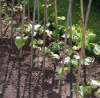
Beans are diuretic, but these little black turtle beans are good for stamina. When the kidneys are tired and people are suffering from fatigue as well as fluid retention and/or edema, this soup can be consumed in large quantities on a daily basis for weeks or months.
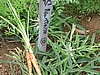
Wonderfully uniform, medium long, blunt tipped roots. Sweet and very juicy. Keeps its quality through a long season. Excellent storage variety. Best yet!
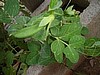
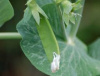
Beautiful purple/pink bicolor blossoms are borne on sturdy 6+' vines. The seemingly endless harvest of snow peas stay tender and sweet even as the pods mature and swell. An heirloom native to Switzerland, the name translates as "Swiss Giant".
Cobham Improved is an outstanding later maturing variety. Its roots grow to 8 inches and it is exceptionally high in sugars, which results in a wonderful melt-in-your-mouth flavor. Many Americans serve parsnips glazed with brown sugar and fruit juice at Christmas
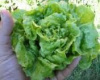
A rich green Batavian type butterhead type of lettuce that forms an amazingly heavy, upright, open, 10 inch diameter head. The leaves are crisp, juicy, and sweet. Victoria also has a long harvest period and the ability to produce in hot weather without bolting or succumbing to bottom rot.
A sharp and tangy flavour. Reminds me of my old time favourite egg and cress sandwiches from home. These have frillier leaves than garden cress. Best sow in the cool of spring or fall to cut seedlings. Transplant and harvest larger leaves as they grow.
Biodynamic agriculture has focused on open pollination of seeds (permitting farmers to grow their own seed) and the development of locally adapted varieties. The seed stock is not controlled by large, multinational seed companies
Compost preparations
Compost preparations, used for preparing compost, employ herbs which are frequently used in medicinal remedies:
502: Yarrow blossoms (Achillea millefolium) are stuffed into urinary bladders from Red Deer (Cervus elaphus), placed in the sun during summer, buried in earth during winter and retrieved in the spring.
503: Chamomile blossoms (Matricaria recutita) are stuffed into small intestines from cattle buried in humus-rich earth in the autumn and retrieved in the spring.
504: Stinging nettle (Urtica dioica) plants in full bloom are stuffed together underground surrounded on all sides by peat for a year.
505: Oakbark (Quercus robur) is chopped in small pieces, placed inside the skull of a domesticated animal, surrounded by peat and buried in earth in a place where lots of rain water runs past.
506: Dandelion flowers (Taraxacum officinale) is stuffed into the peritoneum of cattle and buried in earth during winter and retrieved in the spring.
507: Valerian flowers (Valeriana officinalis) are extracted into water.
508: Horsetail (Equisetum)
Six medicinal herbs – yarrow, chamomile, stinging nettle, oak bark, dandelion, valerian, and horsetail – are instrumental to the production of biodynamic compost.
Yarrow blossoms must be stuffed into the urinary bladder of a red deer. The bladder must be left in the sun all summer, buried during the winter, and dug back up in the spring before it is allowed to be a part of the concoction sprinkled over the compost heap.
Chamomile flowers stuffed into the intestines of a cow are handled similarly although on a different seasonal schedule.
The other herbs are used in specific ways and schedules, too. Once all the ingredients have ”aged” appropriately, they are combined with water and either stirred into a brewing compost heap or they are sprinkled along the top of it.
To enhance the mineral quality of the soil, fresh cow manure mixed with ground quartz needs to be stuffed into cow horns, which are then buried at carefully prescribed intervals along the ground at the right phase of the moon.
The horns are left buried for several seasons, depending upon the exact mixture with which the horn is stuffed. Once dug up after fermentation in the soil, the contents of the horn are mixed with water, whirled in different directions every other minute for an hour, and then sprayed throughout the garden.
Field preparations
Field preparations, for stimulating humus formation:
500: (horn-manure) a humus mixture prepared by filling the horn of a cow with cow manure and burying it in the ground (40–60 cm below the surface) in the autumn. It is left to decompose during the winter and recovered for use the following spring.
501: Crushed powdered quartz prepared by stuffing it into a horn of a cow and buried into the ground in spring and taken out in autumn. It can be mixed with 500 but usually prepared on its own (mixture of 1 tablespoon of quartz powder to 250 liters of water) The mixture is sprayed under very low pressure over the crop during the wet season, in an attempt to prevent fungal diseases. It should be sprayed on an overcast day or early in the morning to prevent burning of the leaves.
Both 500 and 501 are used on fields by stirring about one teaspoon of the contents of a horn in 40–60 liters of water for an hour and whirling it in different directions every second minute. Although some biodynamic beliefs refer to buried quartz "fermenting", a 2004 review commented that it is unclear what this actually means, as rock does not ferment.
Who Was Rudolf Steiner?
Rudolf Steiner (1861-1925), founder of biodynamics, was a highly trained scientist and respected philosopher. Long before many of his contemporaries, Steiner came to the conclusion that western civilization would increasingly bring destruction to itself and the earth if it did not begin to incorporate an objective understanding of the spiritual world and its interrelationship with the physical world. Steiner's spiritual scientific methods and insights have given birth to practical holistic innovations in many fields including education, banking, medicine, psychology, the arts and, not least, agriculture.
Biodynamics Is
An impulse for deep social change rooted in thepractice of farming. Biodynamics calls for new thinkingin every aspect of the food system, from how land is ownedto how farms are capitalized to how food is produced,distributed and prepared.
A type of organic farming that incorporates an understandingof “dynamic” forces in nature not yet fully understoodby science. By working creatively with these subtleenergies, farmers are able to significantly enhancethe health of their farms and the quality and flavorof food.
A recognition that the whole earth is a single,self-regulating, multi-dimensional ecosystem.Biodynamic farmers seek to fashion their farmslikewise as self-regulating, bio-diverse ecosystemsin order to bring health to the land and to theirlocal communities.
Origin of Biodynamics
In the early 1920s, a group of practicing farmers, concerned with the decline in the health of soils, plants and animals, sought the advice of Rudolf Steiner, founder of anthroposophy, who had spent all his life researching and investigating the subtle forces within nature. From a series of lectures and conversations held at Koberwitz, Germany (now in Poland) in June 1924, there emerged the fundamental principles of biodynamic farming and gardening, a unified approach to agriculture that relates the ecology of the farm-organism to that of the entire cosmos. This approach has been under development in many parts of the world ever since. Dr. Ehrenfried Pfeiffer, who worked with Dr. Steiner during the formative period, brought biodynamic concepts to the United States in the 1930s. It was during this period that the Biodynamic Farming and Gardening Association was founded in 1938.