"It better benefit a man to know one herb in the meadow, but to know it thoroughly, than to see the whole meadow without knowing what grows on it" Paracelses.
----------------------------------------------------------------------------------------------------------------------------------------
Self-heal is an extremely valued herb for curing wounds and is extensively used to impede bleeding. Basically native to Europe, self-heal became popular and gained importance when military doctors used the herb not only to cure wounds, but also treat infectious fevers that plagued the royal German army during the period between 1547 and 1566.
In ancient times, the barbs or thorns of the self-heal flowers were thought to look like the throat. Hence, according to the Doctrine of Signatures theory (wherein a part of any plant resembling any organ was thought to be effective in treating the disorders of that particular organ), self-heal was extensively used to cure mouth and throat inflammations. Chinese herbalists extensively use the self-heal flower barbs or spikes, which they call as xu ku cao denoting the ‘summer dry herb’.
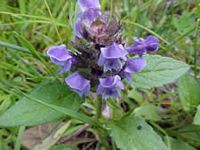
Interestingly, herbalists who have been conducting researches on the herb are baffle as to how the self-heal came to be regarded as a panacea for all ailments as its use has always been very restricted. Self-heal belongs to the mint family as it has a similar square stem, but not the aroma or fragrance associated with other members of the mint family. However, the plant can be distinguished by the group of purple colored flowers growing at the apex of the stems and smaller branches of the plant. Self-heal flowers are arranged in a ring around the spikes and they never blossom all at the same time. As a result, the plant continues to flower over a prolonged period. Incidentally, many herbalists in the 17th century who believed in the Doctrine of Signatures were of the view that since the self-heal flowers resemble the shape of the mouth, they are effective remedies for sore throats, ulcers in the mouth and other related conditions.
Botanically known as Bronella or Pronella, self-heal assumed importance when the German military doctors began using the herb to treat an infectious fever that spread like a wild fire among the royal army between 1547 and 1566. This infection was distinguished by sore throat and a brown coated tongue and consequently, the herb came to be known as ‘the browns’. However, this name did not stick with self-heal for long and botanists offered this ‘heal-all’ plant Latin name.
In the ancient times, herbalists recommended self-heal as an astringent owing to the bitterness of the herb. Seventeenth century herbalist and physician Nicholas Culpepper had observed that when applied on open wounds, self-heal not only impedes the flow of the blood from the wounds, but also repairs the affected area by fusing up the lips of the wounds. In addition, the herb was frequently recommended as a gargle to treat sore throats.
Nicholas Culpeper an English botanist, herbalist, physician, and astrologer, explaining the name 'Self-Heal' whereby when you are hurt, you may heal yourself, as the bruised, fresh leaves and flowers may be applied directly to a fresh wound. While self-heal is not so immediately effective as comfrey, yarrow, or bugle, it is a good herb to know about because of its almost universal presence and availability. One of its popular names "Carpenters Herb", indicates that it was traditionally used for many a mashed, bruised or cut finger.
Disclaimer: Statements contained herein have not been evaluated by the Food and Drug Administration. These products are not intended to diagnose, treat and cure or prevent disease.